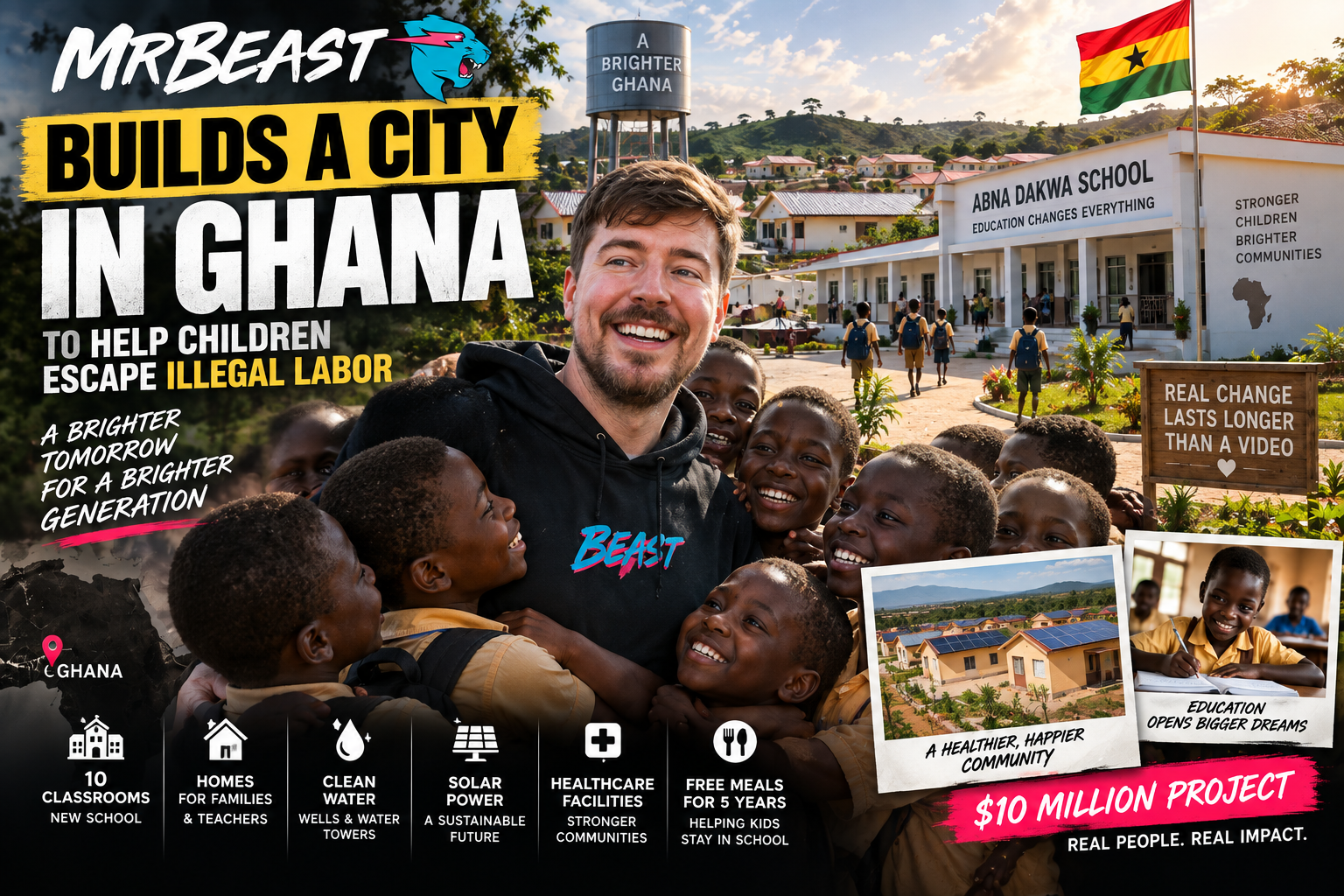
MrBeast new video takes viewers to Ghana, where Jimmy Donaldson has documented a major community project designed to improve education, healthcare, clean water and living conditions for children and families.
What MrBeast New Video Reveals About the Ghana Project?
The MrBeast new video also shows how the project combines infrastructure with education, clean water and other community services. The scale is familiar for a MrBeast production. The purpose is different. Instead of asking how much money can be given away in a single video, the project asks a more complicated question: what happens when money is spent on the infrastructure that can make education and a stable community possible?
The real story is what happens after the cameras leave
The headline figure of nearly $10 million is likely to attract the most attention, but the more important part of the project is where that money went.
Reporting on Abna Dakwa Village says the development includes a school designed for more than 300 students, 10 homes for teachers, a medical clinic, a community marketplace, housing, water towers and an off-grid solar power system. Agricultural facilities, including fish tanks, are also part of the development.
There is also a five-year school-meal programme intended to remove one of the everyday barriers that can affect school attendance. The meals are reported to be supported by the Rockefeller Foundation.
That combination matters.
A school building can increase access to education, but attendance can still be affected by household finances, food insecurity, distance and the availability of basic services. The project attempts to address several of these practical problems at the same time.
Why cocoa farming is central to the story
Ghana is one of the world’s major cocoa-producing countries, and child labour in agricultural communities is not a problem that can be solved simply by telling children to stop working.
UNICEF says about 21% of children aged 5 to 17 in Ghana are involved in child labour, with the problem twice as common in rural areas. Agriculture is a major part of the issue.
The U.S. Department of Labor’s 2024 findings also identify cocoa production among the sectors where children can be exposed to dangerous work, including land clearing, handling heavy loads, harvesting activities and exposure to agricultural chemicals.
This is why the economic side of the story is important.
The wider context shown in the MrBeast new video is connected to child labour concerns in Ghana’s cocoa-growing communities. For families living in rural communities, child labour can sometimes be connected to household poverty and limited access to services. The International Labour Organization has specifically highlighted low household income and limited sustainable livelihood opportunities as factors connected to child labour in Ghana’s cocoa-growing areas.
That means a long-term solution requires more than removing children from farms. Families also need realistic alternatives.
MrBeast’s project tries to build those alternatives
The Ghana development appears to follow that broader approach.
The school provides a place for children to study. Teacher housing can make it easier to attract and retain educators. Clean-water infrastructure reduces dependence on unreliable sources. Solar power provides an independent energy system, while the marketplace and agricultural facilities are intended to give the community economic activity of its own.
The reported plan also includes free school-day meals for five years, creating an additional incentive for children to remain in education.
This is an important distinction from traditional charity.
A one-time donation solves a short-term problem. Infrastructure can potentially continue providing value for years. But infrastructure is not automatically a permanent solution. Buildings need maintenance. Teachers need salaries and support. Water systems require repairs. Solar equipment eventually needs servicing or replacement. A marketplace needs customers and local businesses. Most importantly, families need sustainable incomes.
The success of the project will therefore depend on what happens after the initial construction phase.
The project took months to build
According to reporting about the video, the village was developed through approximately one year of planning and eight months of physical construction.
The development reportedly included a 10-classroom school and improvements to drainage around the community. The Creator Wire reported that the project expanded drainage capacity to reduce flooding between the new village and surrounding areas.
That detail may sound less dramatic than a new house or school, but it illustrates an important reality of development projects: basic infrastructure often determines whether bigger investments actually work.
A school that becomes difficult to reach during heavy rainfall cannot deliver the same benefit as a school with reliable access.
This also changes the role of MrBeast as a creator
MrBeast has spent years turning YouTube entertainment into a large commercial ecosystem. His latest Ghana project shows another direction for that model.
The creator is using the attention generated by entertainment to bring a development issue to an audience of hundreds of millions.
That creates a different kind of pressure.
The video does not only show what was built. It puts the cocoa supply chain itself under scrutiny and connects consumers with the conditions faced by communities producing a product used by the global chocolate industry.
The project has also been linked to MrBeast’s Feastables brand, which has promoted ethically sourced cocoa and used its platform to discuss child labour in cocoa production.
The wider initiative involved organisations including the 1 Billion Followers Summit, the Varkey Foundation and Mohammed bin Rashid Al Maktoum Global Initiatives, while other creators reportedly travelled to Ghana to participate in the build.
The difficult question: can one village change a much bigger system?
This is where the story becomes more complicated.
Building one community can directly improve conditions for the people living there. But Ghana’s cocoa sector is much larger than a single village.
The ILO and UNICEF estimated that nearly 138 million children globally were involved in child labour in 2024, including about 54 million in hazardous work. Their research also stresses the importance of education, social protection and decent work opportunities for adults in reducing child labour.
Ghana itself has been working on broader measures. The U.S. Department of Labor says the country has implemented programmes focused on education, social protection, child-labour monitoring and cocoa supply-chain traceability.
That broader context is important because philanthropy can complement public policy, but it cannot replace functioning institutions or sustainable household incomes.
MrBeast’s village can demonstrate what a concentrated investment can achieve. The bigger test is whether similar improvements can be scaled across other cocoa-producing communities.
What could come next for MrBeast?
The Ghana project could become significant beyond a single viral video because it demonstrates how creator businesses can combine entertainment, commercial partnerships and philanthropy.
MrBeast’s audience gives him something traditional charities often struggle to obtain: enormous global attention in a very short period.
But attention is only the first step.
If the project continues to operate successfully over the coming years, it could become a case study in how online creators can fund and publicise long-term development projects. If maintenance, funding or community participation become problems, it would also demonstrate the limits of building infrastructure without a sustainable support system.
That is why the most important number from this project may ultimately not be the $10 million price tag or the video’s view count.
It will be whether children who might otherwise have worked on farms remain in school, whether families gain more secure economic opportunities and whether the village continues functioning years after the original YouTube video disappears from the trending page.
MrBeast Ghana Project: Key Facts
- Creator: Jimmy Donaldson, known as MrBeast
- Video: “I Built A City To Save Kids From Illegal Labor”
- Release: September 19, 2026
- Location: Ghana
- Community: Abna Dakwa Village
- Reported investment: Nearly $10 million
- Development: Around one year of planning/development, followed by months of construction
- Education: School designed for more than 300 students
- Teacher housing: 10 homes reported
- Other facilities: Medical clinic, marketplace, water towers, solar power, housing and agricultural facilities
- Student support: Free school-day meals reported for five years
- Main focus: Improving access to education and basic services while reducing pressures linked to child labour
Final Takeaway
MrBeast new video is easy to view as another enormous YouTube production. But the more important story is the development model behind it.
The Ghana project combines education, housing, water, energy, healthcare and food support rather than treating child labour as a problem with a single solution.
That does not guarantee that the project will eliminate child labour in the surrounding area. The long-term outcome will depend on local participation, maintenance, family income, education access and the wider cocoa economy.
Still, the project highlights an increasingly important role for creators with global audiences: not simply raising awareness, but using their platforms and business resources to finance projects that can be measured in years rather than views.
For MrBeast new video may be another major upload. For Abna Dakwa, the real story begins after the upload ends.
Source note: Project-specific figures and facility details have been cross-checked against current reporting from Hindustan Times, Indian Express, Dexerto and The Creator Wire. Broader child-labour context has been checked against ILO, UNICEF and the U.S. Department of Labor. Some project figures remain reported figures rather than independently audited financial data.